Middle Tennessee by road
5 nights against 6.37 hours: reserve a 5 night Natchez Trace trip from Cincinnati
The road is a morning. 6.37 hours at the wheel, five nights booked at the end of it, which works out to 1.27 hours of driving carried by each night on the ground.
Nothing is held here until the office has written back and you have said yes to what it wrote. No part of a stay is ever paid for through these pages.
- Road from Fountain Square
- 328.8 miles
- Hours at the wheel
- 6.37
- Nights the office books
- 5
- Hours of road per night
- 1.27
- From
- $975 per person
Hours and miles are measured along the road from Fountain Square, not drawn straight on a map, and they assume clear traffic. Your own run will differ with weather, roadworks and the hour you leave.
Cincinnati to the northern end of the parkway
Go Air Travels will reserve a 5 night Natchez Trace trip from Cincinnati, and the road is measured before the stay is offered. From Fountain Square the drive runs 328.8 miles, which is 6.37 hours at the wheel. Spread across the five nights the office books, that comes to 1.27 hours of driving for each night on the ground. On the office list this entry sits on the second step of four, the step where the road is a morning rather than a day.
The line south is plain and it is mostly interstate. Kentucky first, the Ohio River wide under the bridge at Louisville, then the long run through the cave country and down into the Nashville basin. The parkway begins southwest of Nashville, and the last part of the approach leaves the interstate for a state highway through farmland. A car that pulls out in the morning is on the parkway the same day, with the afternoon still in hand.
The way home is the same road and the same 6.37 hours, and the office says so before the booking rather than after it. Nothing about this trip works without the car. It carries the traveler down, it carries them along the parkway every day, and it carries them back.
A road with nothing sold along it
The Natchez Trace Parkway is two lanes of quiet pavement laid along the line of an old walking and riding road. Commercial traffic is kept off it. There are no billboards, no fuel pumps and no roadside stands anywhere on its length, which surprises most people on the first day. Gas, groceries and dinner come from the towns that sit a short turn off the parkway.
Access is limited, so the road does not collect stoplights or crossing traffic. What it collects instead is pull offs: overlooks, creek crossings, short trails, and places where the sunken original trace is still walkable under the trees. Some are a few steps from the car. Others are proper walks and want boots.
Cyclists use the parkway heavily and cars are expected to give them the lane. The surface is smooth, the curves are gentle, and the driving itself asks very little once the interstate is behind.
Five nights, and what fills them
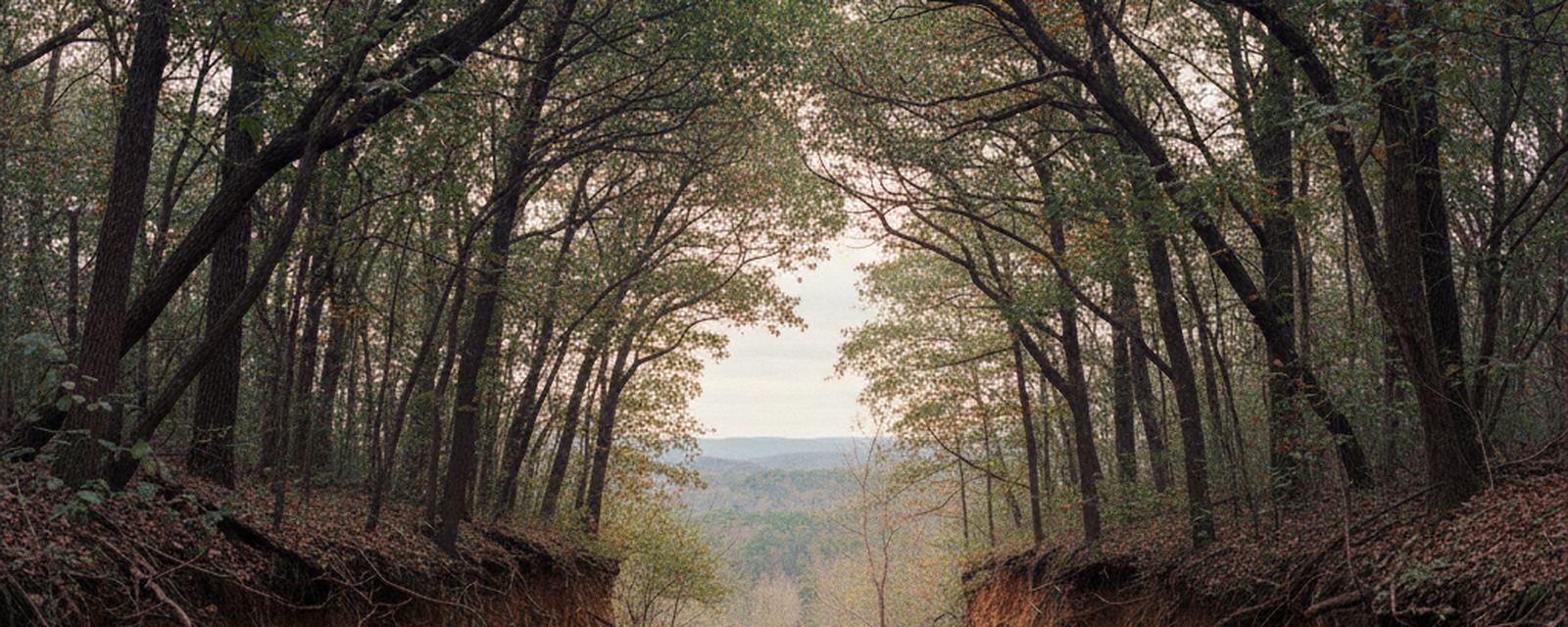
The stretch inside Tennessee is the part these nights are built around. The sunken trace shows up again and again, a worn channel pressed below the level of the ground by generations of feet and hooves. Walking a piece of it is the closest the trip comes to the reason the road exists at all.
Jackson Falls drops in two stages toward the Duck River, down a paved path with steps. Baker Bluff looks out over a valley that farming has kept open. Metal Ford sits on the Buffalo River where wagons once crossed, and the water there runs shallow and clear enough to wade in summer. Near Hohenwald the Meriwether Lewis site holds a pioneer cemetery and a rebuilt stand, which is what a roadside inn was called when this was the only road through.
Two of the five nights usually go to something other than the parkway, on purpose. Leiper's Fork is a village of a few blocks near the northern end. Franklin and Columbia are proper towns with walkable centers, old squares and bookshops, and either one makes a rest day that barely involves the car.
What the windshield shows on the way down
The first part of the drive is ordinary and it is meant to be. Interstate, trucks, service plazas, the river crossing at Louisville. Then Kentucky goes green and lumpy, limestone and sinkholes under the pasture, and the country starts to feel southern well before the state line.
South of Nashville the traffic thins out quickly. The last approach runs past horse fences and low ridges, and the parkway entrance arrives with almost no announcement: a sign, a narrowing, and a road with nothing for sale on it.
The double arch bridge at Birdsong Hollow comes early. Crossing it is undramatic, which is the intent; the bridge was built to be looked at from the road below, where the two spans stand clear of the hollow without a support in the middle.
How the booking is put together
The price starts at from $975 per person and it covers the nights, not the road. Go Air Travels books one base off the parkway for all five nights, so the car is loaded once and unloaded once, and each day runs out and back along the same road.
The request form asks for the dates, the number of people and how much walking is wanted. The office replies in writing with the base town, the room, the total and a list of what the total leaves out. Nothing is held until that is agreed, and no money is taken on this site.
No transport is arranged at any stage. Go Air Travels measures roads and books rooms; the car, the driving and anything hired along the way stay with the traveler. It is an independent reservations office, tied to no lodging and speaking for no operator.
What the figure holds
- Five nights of lodging in one base town off the parkway, held and confirmed in writing before departure
- A route sheet for the 328.8 road miles, with every turn written out and the parkway entrance marked
- A day by day plan for the five nights, naming the stops and saying how much walking each one asks
- Parking for the car at the base, since every day of this trip depends on it
- Written answers about the road and the stops, before departure and during the five nights
What it leaves to you
- Carriage of any kind. The office books beds; getting there and moving around stay with the traveler
- Fuel, tolls and anything the car needs on the way down or back
- Meals, apart from whatever the lodging serves with the room
- Insurance of any kind. The office does not sell it, arrange it or advise on it
- Rentals on the rivers and entry to anything that charges at the door
The office adds no booking fee of its own. What you pay is what each supplier charges, and the written offer shows each line separately.
When this one is worth the road
Middle Tennessee reads differently in each half of the year, and the road is worth 6.37 hours in most of them. April and early May bring redbud and dogwood along the cuts, and the creeks run full. Summer is humid, heavy green, with storms that build in the afternoon and clear by evening; it is also the only season for wading the Buffalo River. Color comes late in October in an ordinary year, though no year is promised and nobody can hold the weather to a date. Winter strips the trees and opens views that the canopy hides for eight months, but ice can shut a section of the parkway for a day at a time, and some stops sit closed. The office will say which of these the requested dates fall into before anything is held.
Does the price cover getting to Tennessee?
No. The 328.8 road miles are driven in the traveler's own car, and fuel is not in the price. Go Air Travels arranges no transport of any kind. It measures the road and books the nights at the other end of it.
What does 1.27 hours a night actually mean?
It is the whole drive divided by the nights booked. 6.37 hours at the wheel across 5 nights comes to 1.27 hours of driving carried by each night. On the office list that is the second step of four, the step where the road is a morning rather than a full day out.
Can the five nights sit in more than one town?
Yes, if the request says so. One base is the default, because the parkway is reached from the same side each morning and a second move costs part of a day. A split is written into the confirmation before anything is held.
Nothing in this list moves you. Getting from one place to the next is outside what this office reserves and it signs nothing with any carrier; you take your own car, and the office books what waits at the far end.
Start with the number of nights
Tell the office how many nights you have. Everything else follows from that number, including whether the drive is worth making at all.